Tap/click here for instructions.
Choose an item below by tapping/clicking on it.
After reading, tap/click on the heading again to close it.
Foreword
As the curtains of 2025 come down, we welcome a dawn of a new era. The year 2025 was unique in its own ways. The VUCA (volatility, uncertainty, complexity and ambiguity) did characterise the environment in which we lived and ministered to as a church. The social, economic and political landscape was very difficult to define. There were moments when fig trees failed to produce figs; cattle and goats disappeared from the stalls; crops failed and no food in the fields; storms erupted along the way. However, despite all these, we trusted God, and He carried us on His wings like an eagle (Exodus 19: 4). The God of the mountain was, and is still the God of the valley (1 Kings 20: 23-27). He was with us in all circumstances.
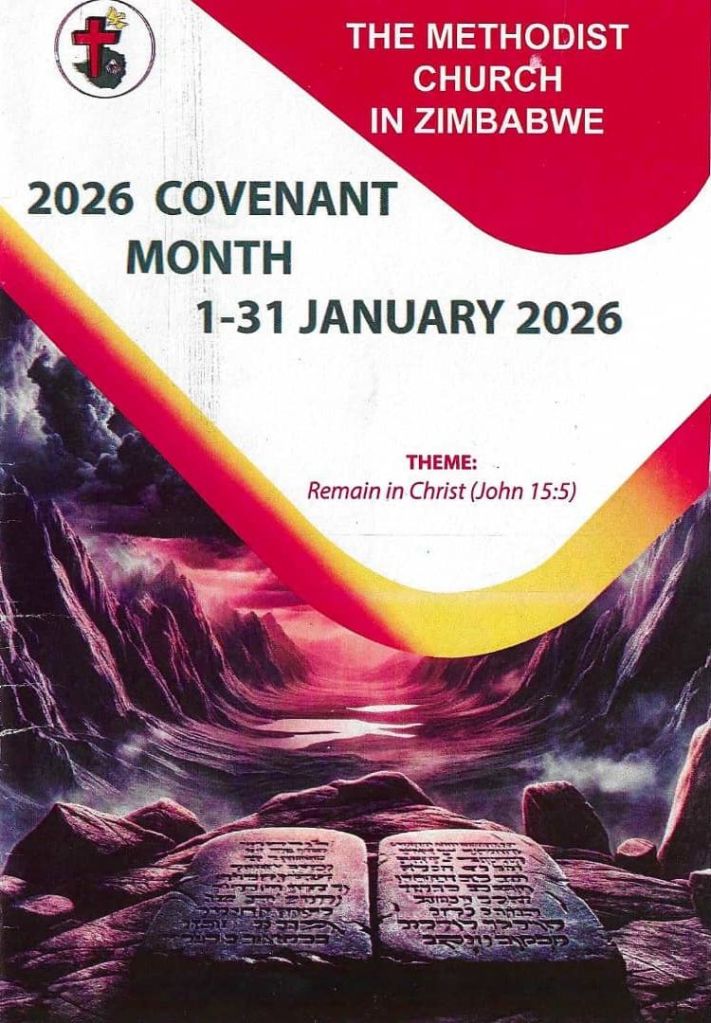
Now that He has proved to us that He is the same God in all circumstances, where else can we go? Even Peter asked this question to the Lord Jesus Christ (John 6: 68). Absolutely nowhere. We remain in Him (Christ). Hence our theme for 2026 says, ‘Remain in Christ’ (John 15: 5) and it calls for people called Methodists to make Christ not only their refuge, but their domicile no matter whatever circumstance.
In that spirit and understanding, we are meeting again as people called Methodists and as people of the covenant during the first month of the year to enter into covenant with God as well as renewing the previous covenants whose results we may be feeling that they were not fully realised during the previous year. The fact that we are people of the covenant entails that we are not ordinary people. We belong to a special Kingdom and that is where we dwell.
It is in this regard that this booklet was prepared so as to help us lay a solid and firm foundation as we embark on this pilgrimage of life with Christ as the master minder of the journey. Topics are articulated in a way that will help us reflect on our call, mandate and position in the Body of Christ as we seek to know Him and make Him known. Furthermore, the month of January, being the first month, lays the foundation of the year, and it is a period that we make resolutions for the whole year. Each resolution is accompanied by a seed. This means that we also take the month as seedtime. In this regard, the booklet was also prepared in a way that it helps us do the right thing the right way and at the right time, i.e. seeding. The last week of the month is seeding week. May we utilise this period for our spiritual and physical nourishment. This book is ours; let us use it.
May God bless people called Methodists.
Revd. Dr. Paradza (Mission Director)
Acknowledgements
This publication of the 2026 Covenant Month Booklet was prepared by Revds, G. Chiwara, C.B. Marasha, K. Matemba and O. Chagudhuma.
May God bless them abundantly.
Revd. O. Chagudhuma
(Media, Research and Publications Coordinator)
1 January 2026
Theme Introduction: “Remain in Christ”
Reading: John 15: 1-8
We thank God for His grace that has sustained us throughout the year 2025. As we embark on a journey with God in the year 2026, we are called to, ‘Remain in Christ’. Chapter 15 of the Gospel according to John is part of the ‘Farewell Discourses’ of our Lord Jesus Christ. The section provides final teachings by Jesus Christ to His disciples before His arrest. Despite what was going to happen to Him, i.e. arrest, trials, crucifixion, death and resurrection, Christ stressed on the continuous relationship that should continue to exist between Him and His disciples. He explains this relationship in an analogy of a vine, the branches and the vinedresser. The words of Jesus in John 15: 5 are both profound and practical. He says, “I am the vine; you are the branches. If you remain in me and I in you, you will bear much fruit; apart from me you can do nothing.” This verse introduces our Covenant Month theme, calling every believer to dwell, abide, and stay connected to Christ daily. The key word in this case is abide, and it is used eleven times in John 15: 1-11 (continue in John 15: 9 and “remain” in John 15: 11). To ‘abide’ means to keep in fellowship with Christ so that His life can work in and through us to produce fruit. This certainly involves the Word of God and the confession of sin so that nothing hinders our communion with Him (John 15: 3). It also involves obeying Him because we love Him (John 15: 9-10).
When our Lord Jesus Christ says that we should ‘Remain in Him, and Him in us’ He is emphasizing on mutual relationship. In other words, it is not only us who abide in Him but Him as our Lord abides in us as well. However, the statement carries with it the notion of choices and decisions that are made by Christians out of free will. As His disciples, remaining in Him is a matter of choice. Christ does not force us to remain or abide
in Him. However, He tells us the benefits of abiding in Him, and the consequences of not abiding in Him. The choice is ours. However, just as the Israelites were advised by God to choose life and live (Deuteronomy 30: 19), so it is with us.
In the Methodist tradition, the Covenant Month is a sacred time of recommitting ourselves to God. This year’s call, “Remain in Christ,” urges us to examine our spiritual connection to the True Vine. In a world shaken by drug and substance abuse, political instability, economic hardship, and spiritual confusion, Christ alone remains our unshakable source of life
Ask yourself: “Is my life flowing from Christ?” To remain in Christ means to seek Him in prayer and to obey His Word. It is also loving His people, and trusting Him even when the world offers alternative sources of identity and power.
Reflection questions
What distracts me from abiding in Christ daily?
How can I use this Covenant Month to renew my spiritual connection?
Prayer
Lord Jesus, help me to remain in You this year. I choose to abide in Your love, truth, and presence, for from you alone comes the power to be fruitful. Make me fruitful and faithful in all that I do. Amen
2 January 2026
Topic: Flourishing by remaining in Christ
Reading: Psalm 1: 1-3
In a dry season, or drought, the river may shrink, exposing the sand from underneath it. However, the riverbanks (sandbank) remain one of the few places from where water can still be found. If people dig into the sand, they can access the cool and refreshing water, even in the midst of scorching sun. If people can come to the river banks for water during the dry seasons, what more for the trees that are planted by the river bank?
The Psalmist uses the powerful imagery which expresses the importance of water for plants. For him, a tree that is planted by the stream is a symbol of stability, nourishment, vitality (life). It has access to unlimited and continued source of life. Such trees have green leaves, and bear fruit in season. Water, in the Bible, represents life. The psalmist paints a picture of the person who delights in the Word of God, who will be “like a tree planted by streams of water, which yields its fruit in season and whose leaf does not wither.” This is what it looks like to remain in Christ. One is nourished, and experiences strength and wellness in all the aspects of his life.
There are moments when life may feel like a drought, when you have no hope; when your business is at its low, when your child is abusing drugs and substances; when you are betrayed by your loved ones; or due to ill health. But those who remain in Christ throughout all the seasons, like the tree in Psalm 1 : 1-3, can still draw strength and life from God’s presence. Two things are important here: sustenance in difficult times (dry seasons) and fruitfulness in the right season.
God is exhorting us to remain deeply rooted in Christ, so that we may constantly be nourished, and unshaken by dry’ seasons. A Christian who remains spiritually hydrated by God’s Word and presence thrives even in hard times.
Reflection question
In what practical ways does “fruitfulness in season” look like practically in your family, work, ministry or community?
Prayer
Father, help me to remain connected to you through Christ, so that I grow strong and fruitful. Keep me from dryness and wandering.
3 January 2026
Topic: Rooted and built up in Christ
Reading: Colossians 2: 6-7
Paul reminds the Colossians to, “Continue to live your lives in Him, rooted and built up in Him, strengthened in the faith.” Remaining in Christ requires us to commit ourselves fully to Him. It is going deeper, just like the roots of a tree burrow into the soil. The roots do not remain on the surface. Additionally, the tap root burrows down further into the soil in order to access and remain connected to the source of vitality. We can also learn from the building structures. Shallow foundations crack quickly. so do shallow faiths.
This is why the church is required to disciple believers to be spiritually grounded. We should be rooted in Christ. This enables us to remain standing, even when facing pressure from unbiblical teachings, economic challenges, facing problems within your marriage or family struggles, our foundation must be Christ.
As a child of God, make intentional efforts to deepen your faith. Join Bible studies (Kokorodzano), seek doctrinal soundness, and walk with fellow believers. Do not live on borrowed faith or emotions. You must go deeper in Christ.
Reflection questions
What weakens our spiritual foundation, and how can it be strengthened?
What practical step can I take to grow deeper in Christ?
Prayer
Lord, may I be rooted in Your truth, not in the shifting values of the world Strengthen my faith and build me up in You. Amen.
4 January 2026
Topic: Our lifeline in Christ
Reading: John 15: 4-8
Jesus uses the vine and branches to explain the necessity of union with Him. “No branch can bear fruit by itself.” This is a wake-up call. Christianity is not about self-reliance but divine connection. In the church today, some trust in status, tradition, or “religious performance.” There are some leaders and preachers who think that they can make it in the ministry due to their vast experience in leadership and preaching. Others think that they can make it because of their education. Some believers also think that the length of time that they have been Christians is the sole reason that they can conquer.
While all these are good, they are not substitutes for a real, living connection to Christ. Without a connection to Christ, our sermons become great speeches, theological discourses or entertainment. Our singing and preaching Can also become mere performances. If you are not plugged into the True Vine, your fruit is empty.
May we stay connected to Christ daily through worship, obedience, and fellowship. Without Him, all efforts, no matter how impressive they may be, bear no eternal fruit.
Reflection questions:
As individuals, or the church, are we not trying to bear fruit without staying in the Vine?
How can I re-establish a personal connection with Christ?
Jesus, help me not to rely on myself, but on You. Let my life bear fruit that glorifies You. Amen.
5 January 2026
Topic: Abiding in Christ and bearing fruit
Reading: Galatians 5: 22-23
You might have heard someone saying that you must do good things or love others so that God might accept you. This has caused many people to make efforts ‘to do good’ and to be a person of love. However, this has led many people to frustration, as they have failed to do good, just like the rich young ruler of Matthew 19: 16-30, Mark 10: 17-31 and Luke 18: 18-30, who thought that he would be saved by what he does. The Bible indicates that due to his focus on what he could do (What should I do’…) he was a frustrated man.
The virtues that we all desire for, such as love, joy, peace, patience, kindness, and more, are not manufactured through effort. You cannot practice to love, or be trained to love. We do not do good things in order to be saved. But we can do good things because we are saved. It is a fruit of the Holy Spirit that comes through remaining in Christ.
When believers abide in Christ, the fruit shows in character, relationships, and witness. Is this so in your life, family, church, and community? Your faith must bear visible evidence. Evaluate your life. Are you growing in Christ-like character? Let us remain in Christ, and be renewed by the Holy Spirit.
Reflection questions
What spiritual fruit is missing in my life?
Who benefits from the fruit I bear?
Prayer
Holy Spirit, grow Your fruit in me. Where I am impatient, bitter, or unkind, change me. Let my life reflect Jesus. Amen.
6 January 2026
Topic: Not swayed like clouds: Stability in Christ
Reading: Ephesians 4: 14
In a world characterised by various challenges, many voices have arisen, offering different solutions. Some of these solutions are packaged in magic, miracles, sermons, and Bible teachings, among others. Due to despair, some Christians have resorted to various sources of help, especially those that are offered in the name of Jesus, and Bible verses being quoted. However, for some, what appeared to be solutions have proved to be traps. This is the reason we have read the news about some people who have been duped, conned or even abused by those who had offered help.
Paul warns against being “tossed to and fro by every wind of doctrine”. In our time, false teachings, disguised as the ‘true gospel’, especially via social media and other media platforms, are leading many astray. Remaining in Christ includes remaining in sound doctrine.
The Methodist Church has always valued scriptural holiness and theological integrity. Children of God must reject spiritual fads (trends/waves) and emotionalism. We must stand firm in the truth and strengthen our understanding of biblical truth. Listen critically. Examine all teachings in light of Scripture. Do not let strange doctrines shake your faith.
Reflection questions
What teachings have influenced me recently? Are they biblical?
How can I grow in my understanding of sound doctrine?
Discussion point
How can Christians distinguish sound Biblical teaching from unsound doctrine?
Prayer
God of truth, anchor me in Your Word. Protect me from deception, and help me grow in discernment. Amen.
7 January 2026
Topic: Answered prayers through remaining in Christ.
Readings: 2 Timothy 4: 2-4; Acts 17: 11; James 1: 6-8
Those who remain in Christ can have their prayers answered. It helps them to focus on Jesus, and Jesus alone. At times believers feel their prayers go unanswered, yet the problem may be in faulty teaching. Paul warns Timothy about a time when people will “gather around them a great number of teachers to say what their itching ears want to hear.”
The Bereans were different. They examined the Scriptures daily. Sound doctrine does not only preserve truth; it sharpens prayer, aligns our desires with God’s will, and builds faith that pleases Him
As a child of God, study God’s Word with humility and care. Compare teachings with Scripture. Let the truth form your prayers. In a time of spiritual confusion, be like the Bereans.
Reflection questions
Do I test teachings against Scripture like the Bereans?
Are my prayers aligned to God’s will and to sound doctrine?
Prayer
Lord, teach me to love and live by Your truth. Correct my thinking and empower my prayers. Amen.
8 January 2026
Topic: Remaining in Christ through His Word
Readings: John 15: 7; Matthew 4: 4
Jesus said, “If you remain in me and my words remain in you, ask whatever you wish, and it will be done for you.” Remaining in Christ is not possible without remaining in His Word. Scripture is not only information. It brings transformation to the Believer. It also helps one to overcome.
When Jesus was tempted in the wilderness, He answered Satan with, “It is written.” He stood on the Word. For Methodists, reading, studying, preaching, and obeying the Bible must remain central to our faith. For John Wesley, the Methodists are the people of one book. In a context of social media distractions and spiritual shortcuts, believers must recommit to Scripture. Take time daily to read and meditate on the Word. Let it form your worldview and response to life. Encourage your family and church community to engage with Scripture.
Reflection questions
How often do I feed on the Word of God?
What is one verse I can meditate on today?
Prayer
Lord Jesus, help me to treasure Your Word. May it live in me richly and shape my thoughts, actions, and desires. Amen.
9 January 2026
Theme: Practising Faith through Prayer
Readings: Daniel 9: 1-19; Luke 11: 1-13; 1 Thessalonians 5: 17
The prayer life of some believers is transactional. They only resort to prayer when they want something from God, or when they are in a crisis. They do so when they have been summoned to a hearing at the workplace, when they do not have money, when a child is not feeling well, or when their marriage is not doing well.
Prayer is the lifeline of the believer. Jesus often withdrew to lonely places to pray. His disciples saw the power of His prayer life and asked, “Lord, teach us to pray.” Remaining in Christ is sustained through communion with Him in prayer. In times of trouble, confusion, and joy, prayer keeps us anchored. The Spirit helps us in our weakness when we do not know how to pray.
However, a child of God must remain connected to God through prayer, even when all is well. Prayer should not be reduced to emergencies. Make it your habit, not just a ritual. Pray in the Spirit. Pray with understanding. Teach your children and congregants to pray. It keeps you plugged to the source of life, blessings and strength.
Reflection/Discussion
In Daniel 9: 1-19, what does Daniel’s prayer for the Jewish and Jerusalem incorporate besides intercession.
What kind of model does the Lord’s prayer provide in Matthew 6: 9-13? Does it involve elements of praise, thanksgiving, intercession or confession?
Prayer
Father, draw me into deeper communion with You. Teach me to pray as Jesus prayed. Let my life be a life of unceasing prayer. Amen.
10 January 2026
Topic: Remaining in Christ through the Holy Spirit
Reading: Acts 1: 4-8; Romans 8: 9-14
Jesus instructed His disciples, “Do not leave Jerusalem, but wait for the gift my Father promised.” They had to remain until the Holy Spirit came upon them. Remaining in Christ involves surrendering to the Holy Spirit daily. The Spirit heals, teaches, convicts, empowers, and transforms.
In many churches today, emotional experiences are mistaken for the work of the Spirit. But the true sign of the Spirit is Christlikeness, holiness, and power to witness. Invite the Holy Spirit to lead you each day. Surrender your plans and walk in obedience. Seek the Spirit not for display, but for fruitfulness and strength.
Reflection question
Am I relying on the Holy Spirit or on self?
Prayer
Holy Spirit, fill me afresh. Lead me, teach me, and glorify Jesus in my life. Amen.
11 January 2026
Topic: Power comes from remaining in Christ
Readings: Acts 2: 1-4; Acts 4: 13
Remaining in Christ brings observable transformation on an individual. This can be in character, love, and other virtues. Because the apostles were always with Jesus, they were transformed to an extent that the people realised that they were no longer the ordinary, unlearned Galileans that they knew. The Bible says that people “took note that these men had been with Jesus.” Remaining in Christ produces boldness, clarity, and impact.
If you remain connected to Christ through fellowship with believers, consistent prayer life, reading and meditating upon the Word, and attending church services regularly, you will be transformed. You will be transformed from being a coward, to face life challenges with resolve. You will be transformed from being fearful to witness Christ to strangers and to speak about him openly to your friends, relatives, neighbours or workmates.
As a child of God, are people able to tell that you have “been with Jesus”? Does your spiritual life overflow into action? Don’t chase popularity or relevance. Remain in Christ and His power will show.
Reflection questions
How can we spend time with Jesus?
Prayer
Lord, may others see You in me. Fill me with boldness and clarity as I walk in Your presence. Amen.
12 January 2026
Topic: Overcoming fear
Readings: Proverbs 28:1; 1 John 2: 28-29
One of the weapons used by the devil against Christians is fear. It brings bondage, torment, weakens the child of God, paralyses decision-making and blinds us from seeing the hand of God in our lives. Proverbs 28: 1 says that “The wicked flee though no one pursues, but the righteous are as bold as a lion” When we remain in Christ, we walk in righteousness, and righteousness produces confidence. We no longer shrink back in fear or compromise.
In today’s world, believers often face ridicule, opposition, and rejection. Some are also gripped with the fear of the unknown. But Christ calls us to stand firm. We all need this reminder: remaining in Christ gives strength to stand when others fall. Renew your spiritual identity in Christ. Refuse to walk in shame or timidity. Your strength to overcome fear comes from being a child of God, not from your environment.
Prayer
Father, grant me holy boldness to live and speak as Your child. Strengthen my faith and remove all fear. Amen.
13 January 2026
Topic: Loving God and others
Reading: John 15: 9-13; Matthew 22: 37-40
Jesus linked remaining in Him with love: “As the Father has loved me, so have I loved you. Now remain in my love.” Love is the measure of true discipleship. Without love, all our efforts, titles, and rituals are empty.
To remain in Christ is to remain in love. It means we forgive, serve, and care, even when it is hard. Methodism was birthed in a movement of practical love: for the poor, the outcast, and the hurting. This must continue. Renew your commitment to walk in love. Love your family, neighbour, and fellow church member. Forgive and show mercy. Love is not a feeling; it is a choice to remain in Christ.
Lord help me to love like You love. Where there is bitterness or pride, change my heart. Let me remain in Your love daily. Amen
14 January 2026
Topic: Restoration for those who return to Christ
Readings: Luke 15:11-32; John 15:4
Our theme for this year calls us to not move away from Christ but to abide in God’s presence. The Bible also teaches that to remain in Christ brings blessings victory and protection. You might have strayed away from God’s presence due to some worldly pressures, life challenges, complacency or any other reason. This has exposed you to the dangers of the world without the Lord’s protection. However, there is hope of restoration for you. You need to realise and admit that you have strayed, believe in the saving grace of God and come back to Him with confession.
The parable of the prodigal son reminds us that leaving the presence of the Father brings suffering, shame, and brokenness. When the younger son left home, he thought he was seeking freedom, but he lost everything. His return symbolises confession, humility, and the deep grace of God.
The Lord is calling you back. He welcomes the repentant. In John 6: 39 He says that He does not want to lose any that are given to Him by the Father. Christ calls not only the faithful, but also the fallen to return and remain. Like the prodigal son, many in the church, some may wander, but God is always ready to restore. Have you strayed in heart or deed? Are you interceding for someone who has walked away? Return, or help others return, to the embrace of the Father.
Prayer
Loving Father, thank You for never giving up on me. I return to You. Heal, cleanse, and restore me to abide in Your love. Amen
15 January 2026
Topic: Remaining in Christ through humility and confession
Readings: 1 John 1: 5-10; Genesis 3: 6-13
God’s desire is that we remain in communion with Hm. Furthermore, He also desires that we remain in communion with each other as the children of God. He detests to see one of us moving away from His Presence or from Christian fellowship. However, some Christians when there is a misunderstanding or transgression against one another they do not want to be humble to allow the relationship in Christ to move on. This can also happen within our families or churches. There are some people who have cut themselves off because they failed to admit their failures or mistakes. Adam and Eve hid from God rather than confess. Instead of humbling themselves, they shifted blame. Eve blamed the snake. Adam blamed woman. He even blamed God by saying that it was the woman that God had given Him. The result was exile from Eden the paradise. Symbolically, they exited God’s immediate presence. They lost out on fellowship blessings and protection of God. Even in our everyday lives there are friendships, marriage relationships, fellowship in the church or relationship between siblings that have been lost just because of the refusal to sincerely say ‘l am sorry’.
Remaining in Christ is not perfection but humility. 1 John 1 assures us that “if we confess our sins, He is faithful and just to forgive.” Unconfessed sin builds a wall. Confession restores fellowship. Do not hide from God. Daily confession keeps your relationship alive. Encourage accountability and truthfulness in your family, church groups, and personal life.
Reflection questions
Am I honest with God about my sins and weaknesses?
Is there someone I need to forgive or ask forgiveness from?
Prayer
Lord, 1 confess my failings. Cleanse me. Keep my heart soft and open to You. Amen.
16 January 2026
Topic: Those in Christ are bound by love and compassion
Reading: Luke 13: 10-17
In Luke 13: 10-17, we encounter a God through Christ who opposes the authorities and loosens the chains of people bound. The healing of this crippled woman on a Sabbath shows that God is not at work and active during the working hours only but is ready to work 24/7 for the sake of those in need and is a force that cannot be confined or limited. Jesus breaks the rules of the Sabbath because for Him, people and compassion are more important than laws. The intention of the law is more important than observing the individual laws.
God’s nature is love. Those who are in Him are bound to possess the same character that God is. The life of those in Christ should be to transmit that which is deposited in them through actions, and loosen the bonds, to lift up the downtrodden, and to make people free because God heals and saves.
Reflection/Discussion:
In what ways can we show compassion to the outcasts and down trodden in our society?
Prayer
God of Love, reveal yourself to us and help us to witness to your truth. Free us from the temptation to misuse you in order to take advantage of other people, or to be served rather that to serve. Amen!
17 January 2026
Topic: The tragedy of being in church while you are out of Christ.
Readings: 2 Samuel 14: 23-33; 2 Samuel 15: 1-6
Absalom rebelled against his father, King David. Though he eventually returned to Jerusalem, he refused to truly reconcile. He stayed two years in the city without seeing the king’s face. Outwardly he was home, but inwardly still distant.
There are some Christians who did a good thing by becoming members of the church. They attend church services regularly and religiously attend their organisation’s meetings. Sadly, however, some have become regulars at the church yet they have not committed themselves to Christ such that their sins are forgiven, to enable a heathy relationship with Christ. It is possible to be in the church but away from Christ.
Fellowship with Christ requires more than physical presence in church. It calls for true repentance and connection which allows God to cleanse you and allows heart reconciliation. It also requires faith which enables you to be connected to Jesus. Religious performance without surrender is dangerous. Eventually, Absalom’ s bitterness led to his downfall.
Let us examine ourselves. Are we not like Absalom, who came near the father, yet remained far away from the Father? May we endeavour to seek full reconciliation, not half-hearted religion. Romans 5: 1 says that it is through Christ that we found access to God grace.
Reflection questions
Am I truly reconciled to God, or just going through motions?
Am I in Christ, or only in ‘church’?
Prayer
Father, 1 don’t want to stay near without seeing Your face. Restore my heart fully to You. Amen.
18 January 2026
Topic: Those in Christ help in the promotion of trust
Reading: Romans 14: 7-8
Christians and non-Christians alike are going through a lot of challenges in their lives. These challenges include social, political, economic among others. These challenges lead many people to isolate themselves while some become victims of loneliness,
There are two types of loneliness, namely voluntary and involuntary. Voluntary loneliness occurs with people having challenges connected to social ills, tragedies and traumas linked with their challenges, and have chosen to isolate themselves from social contact. They seek an emotionally remote life without relationships to avoid more losses. On the other hand, involuntary loneliness is a problem for people with challenges who have been rejected and excluded from communities because of their status. They have been shoved out into isolation and do not dare to seek social contact for fear of being condemned and cast out. In Romans 14: 7-8 Paul writes, “We do not live to ourselves and we do not die to ourselves. If we live, we live to the Lord, and if we die, we die to the Lord; so then, whether we live or whether we die, we are the Lord’s”. These words speak directly to the existential loneliness that affect many people with challenges in their life. Knowing that the purpose of all those who have accepted Christ as their Lord and Saviour is to live or die for Him means that there is no room for mistreating others in church or community.
Those who live for the Lord understand that humans exist to help those in need and live for each other so that life can function. However, it’s sad that there are some people even in church, who have a tendency of thinking that they are more equal than others – this is a threat to our fellowship and our quest to remain in Christ.
Discussion:
How can we identify that our colleagues are having a bad time and how best can we help them overcome loneliness?
Prayer
Lord Jesus, give us the power to love each other in season and out of season. Amen
19 January 2026
Topic: In Christ, trials refine us rather than destroy us
Readings: James 1: 2-4; John 16: 33
Jesus teaches us challenges are an inevitable reality in our lives (John 16: 33). Life brings many hardships. We fall sick, our loved ones become ill, we grieve due to death, we encounter marital problems, broken relationships, betrayal, rejections and slander, among others. Yet Scripture teaches us to, “Consider it pure joy when you face trials,” because trials grow perseverance. Jesus never promised a storm-free life, but He promised His presence.
The most important thing in John 16: 33 is that Jesus ends with victory over the world. He has already claimed victory for us. The tragedy of life is not that we encounter challenges, but it is encountering them without Christ. When we remain in Christ, we are not crushed by adversity. May we hold on to Him in faith, pray, wait and continue to trust in Him.
Prayer
Jesus, in the fire of testing, help me endure. Keep me anchored in You that I may come out stronger. Amen.
20 January 2026
Topic: Remaining in Christ involves remaining in fellowship
Readings: Hebrews 10: 24-25; 1 Corinthians 14: 26; Acts 2: 42-47
In an age of individualism, some neglect true Christian community. Some have even gone to the extent of coining an assertion to justify themselves saying, ‘kunamata mayo Wako ‘ (true worship is a matter of the heart, not church attendance). Others have also justified avoiding fellowship by moving with times through virtual worship. (It is understood, though, that for some, physical worship is not easy, beyond their control). Yet the early church “devoted themselves to fellowship.” Remaining in Christ includes being part of His body.
To isolate oneself from the believing community is very dangerous. Isolation weakens faith. An illustration of firewood can be helpful in explaining this. When one stick is pulled out of the fire and isolated, it will not produce a flame. It may produce smoke as its glow dies down. Likewise, the fervency of your faith may die down if you withdraw from the believing community, stop coming to church, or not attending the class or organisational meetings.
Isolation weakens faith. We grow stronger together, through worship, mutual care, correction, and shared mission. When the early church met daily in love, thousands of people were drawn to Christ on a daily basis. Examine yourself. If you had cut yourself off, recommit to your local church. Attend regularly. Encourage others. Be accountable and serve. The church might not be perfect but it is God’s chosen family. Let us delight in fellowshipping in Christ, so that we grow together, to the glory of God.
Reflection question
What are some of the reasons that cause people to stop coming to church and what can we do to address these challenges?
In 1 Corinthians 14: 26 Paul is describing the worship of the Corinthian Church. What are the key aspects of worship indicated in the passage and how are they useful in the life of a Christian today?
Prayer
Lord, thank You for the church. Help me value community, serve with love, and grow in fellowship. Amen.
21 January 2026
Topic: Reaching out to others with the Good News.
Readings: Matthew 28: 18-20; John 20: 21; Psalm 23: 5.
David is one of the people who yearned to remain in the presence of God. In Psalm 23: 6 he vows to dwell in the house of the Lord forever. This reflects a life continually connected to the source of life, blessings and anointing. This is the reason why he is able to declare, in Psalm 23: 5, that, ‘My cup overflows”. He points to a life lived in the abundance of God’s presence. A cup that has constant supply gets filled, and eventually overspills or runs over. Likewise, when you remain in Christ, he continually fills you with His love, truth, blessings, anointing and the Spirit. Naturally, these will overflow to touch those around you.
The Great Commission (Matthew 28: 18-20), Jesus’ sending words (John 20: 21) reminds us that mission is the natural outpouring of those who are continually connected to Christ. To abide in Christ is to be caught up in His mission. The closer we stay to Jesus, the more our hearts break for the lost. The more you remain in Him, the more you are compelled to reach out to others with the Good News. This can be in various forms, such as preaching, acts of love, living a life that witnesses God’s grace, and sharing the glad tidings with your loved ones.
Mission is not born out of human effort alone. It is indeed the overflow of abiding in God’s presence. Strategies for evangelism, by a society, circuit or any other group, may not yield much if it is not connected to Christ. Someone who is disconnected to Christ may struggle to share the Gospel, but for the one who remains connected, it is inevitable. The early church that remained in Christ through fellowship and devoting to the teaching and preaching of the apostles did not struggle to have new converts.
We are called to abide in Christ, so that we can carry God’s love to a wounded and hurting world, and bring light into darkness. Share your faith. Live it out at work, school, or in your home. Be available for Christ’s mission.
Prayer
Lord I abide in You—send me. Let me carry Your presence and proclaim Your good news. Amen.
Personal reflection questions
What one is connected to is reflected through what he or she gives.
As an individual, do I give out love, inspiration to others, and share the Good News of Christ, or I give out negative vibes, pulling down others, or contagious murmuring?
22 January 2026
Topic: Transformed through abiding in Christ
Readings: 2 Corinthians 5: 17; Romans 12: 1-2, Romans 8: 29; 2 Corinthians 3:18; 1 Thessalonians 4: 3; 1 Thessalonians 5: 23-24
One of the aims of our continued devotion to God is becoming more like Him. Our minds, habits, and desires are gradually reshaped. Transformation may be slow, but it is sure. As we abide in Christ, the Holy Spirit works in us, rewiring our attitudes, reactions, and choices. This is true holiness.
John Newton is famed for saying, “1 am not what I ought to be, I am not what I want to be, I am not what I hope to be in another world; but still I am not what I once used to be, and by the grace of God I am what I am”. In simpler terms, he is saying that he was not yet what he was supposed to be, but thankfully he was no longer what he used to be. That is sanctification in one sentence.
It reflects God’s continual work in us. Be assured that what God starts, he carries to completion (Philippians I : 6). God is continually shaping us to be like His Son, our Lord Jesus Christ. Paul says we are predestined to be conformed to the image of His Son (Romans 8: 29) and, as we behold the Lord, we are being transformed into His image from one degree of glory to another. This is a Spirit-driven, ongoing change (2 Corinthians 3: 18).
John Wesley also taught that sanctification has both gradual and sometimes instantaneous dimensions, as God is always working in us through our faith. In Plain Account of Christian Perfection, Wesley affirms an instantaneous, as well as a gradual, work of God in his children.
Remaining in Christ changes who we are and therefore how we live, slowly but surely. It is true that you are not yet perfect, but we thank God you are no longer what you were, by His grace! You are not yet where you might want to be, but you are no longer where you were!
Let us remain in Christ, so that we may continue to grow and mature in spiritual affection (deeper love for God and neighbour – Galatians 5: 22-23), attitudes and reactions (renewed mind – Romans 12: 2), choices and habits (God’s will—our sanctification – 1 Thessalonians 4: 3), whole-person holiness (the God who calls you is faithful to sanctify you through and through – 1 Thessalonians 5: 23-24; Philippians 1: 6).
Personal reflection
In what areas of my life do I still need transformation?
Prayer
Lord Jesus, I surrender every part of my life. As I abide in You, keep changing me. Transform me from the inside out. I thank You I am not what I once was. Make me more like You in heart, mind, and conduct; today and every day. Amen.
23 January 2026
Topic: The call to endurance
Readings: Ecclesiastes 7: 8, Matthew 24: 13, Colossians 4: 17, 2 Timothy 4: 7-8
It is one thing to start a journey, or project, but another thing to complete it. Many begin with enthusiasm, but some fail to endure to the end. In God’s eyes, faithfulness is not only in starting well, but also in finishing faithfully. He who abandons a mission is like a one who never began.
When Paul looked back at the end of his ministry, he was able to declare with confidence: “I have fought the good fight, I have finished the race, I have kept faith”. He was assured of the crown of righteousness that awaited him because he had managed to complete the mission, despite the various challenges that he encountered. Likewise, Jesus, at the end of his earthly mission was able to pray, “I have brought you glory on earth by finishing the work you gave me to do” (John 17: 4). Their lives remind us that the end of matter is better than its beginning (Ecclesiastes 7: 8).
Jesus warned his disciples that persecution, trials and criticism would come, yet he promised: “The one who stands firm to the end will be saved” (Matthew 24: 13). Finishing well requires endurance. The Christian journey is not a sprint, but a marathon. Remain steadfast, even when your trust in the Lord is tested. As a leader in the church, continue to serve with integrity, even when faced with opposition, criticism or misunderstanding.
Endurance is also needed in everyday life. For those who are studying, keep pressing forward, even if you might be struggling to raise the fees, or discouraged with a ‘carry’. You might have embarked on a business or building project as a family, do not lose heart, even in the face of many adversities.
How we end matters. As Paul exhorted Archippus: “See to it that you complete the ministry you have received in the Lord” (Colossians 4: 17), that same charge is made to us today: remain faithful, endure hardship, and finish well.
Reflection
Are there areas in your life in which you are tempted to quit (for example, faith, studies, leadership and others)?
How does remembering the eternal reward of ‘the crown of righteousness’ help you to persevere?
Prayer
Lord, keep me faithful. Let me run my race and finish well. Prepare me for Your coming. Amen.
24 January 2026
Topic: Protection of the fruits of your labour
Readings: Judges 6: 3-6; Isaiah 65: 21-23
The Midianites, Amalekites and other nations did not cultivate any crops, but made it a habit to come and attack the Israelites whenever they would have gathered their harvest. They would plunder all the fruits of their labour. The plundering nations remind us that the enemy often tries to steal our harvest — our success, blessings, or earnings. Unforeseen obstacles, sickness, accidents, or theft can threaten what God has provided. Yet God promises that His people will enjoy the fruits of their labour.
Some people know the stress of working hard, only to face sudden setbacks. A business owner might be affected by unexpected loss, through fire, theft or other factors. A family may face health emergencies just after receiving a blessing. A youth may fall into drug addiction soon after graduation, at a time that he or she is due for employment and miss out the opportunities. The devil often targets moments of breakthrough to rob God’s children of their reward.
However, Isaiah reassures us that God’s children will indeed enjoy their harvest: “They will build houses and dwell in them; they will plant vineyards and eat their fruit. No longer will they build and others live there, or plant and others eat.” (Isaiah 65: 21-22)
As the children of God, we need to be vigilant through prayer in faith. God will protect what He has provided. Malachi 3: 10-11 also shows that through our tithes, God will ‘prevent pests from devouring (our) crops, and the vines in (our) fields will not drop their fruit before it is ripe’. We are also called to be good stewards, who do careful planning. Ethical conduct in our businesses will also prevent you from incurring huge penalties that might jeopardise your business. Trusting God does not mean neglecting responsibility. It means acting with faith while relying on His protection.
Reflection/Discussion
What practical and spiritual practices can help protect the fruit of your labour and finances?
How can prayer, diligence, and obedience work together to safeguard God’s provision?
Prayer
Lord, protect the fruit of our labour. Shield our families, businesses, and resources from theft, loss, and misfortune. Help us trust in Your provision and enjoy the blessings You provide. Amen.
25-31 January 2026
SEEDING WEEK INTRODUCTION
January is the first month of the year. It is also the period when people set their resolutions for the year. In other words, it lays a foundation of what the year is going to be like, and what it is going to bring to each individual. Important to this period is that we lay the foundation metaphorically in the context of an agricultural mind-set. We do seeding festivals in January. There is a lot of debate among church traditions as to whether this practice is biblical, or having biblical basis. Yes, it does have. One thing about seeding in any agricultural setup is that it is not forced. You seed because you wish to harvest and have grain in your stores. But, if you feel that it does not benefit you to plant, it is up to you to do otherwise. Let who wish to benefit from the season seed.
25 January 2026
Topic: Understanding times: A time to seed
Readings: Ecclesiastes 3: 1-2; Genesis 8: 22
Today is the first day into the ‘Seeding Week’. It is a day when we put our faith into action with an understanding that we cannot let the season just pass by, i.e. we cannot be left behind.
According to the texts under study, we are reminded about the God of order whom we worship. In His order God designed seasons and that each activity has to and done in its season. Among the seasons designed by God is seedtime. Genesis 8: 22 is very clear that seedtime will never cease to exist. This means that seasons will always be there. The word [seed] appears 116 times in the Bible. However, what is critical in this regard is that God’s people should have the necessary wisdom so that they do what is right in the right season. Planting is done during seedtime and not during harvest time.
Furthermore, no one can expect harvest where he/she did not sow. First thing first, and has to be done in the right season. As God’s people, we sow and God gives the increase (Psalm 65: 9-13). The season in which we are in at the moment is seedtime. We are encouraged to do what is right, the right way and at the right time if we are to have a good harvest during the course of the year.
Reflection
To everything there is a season. How can I be off-season during the right season? So help me God.
26 January 2026
Topic: Quality and quantity go along when seeding
Reading: 2 Corinthians 9: 6-9
Today is the second day into the ‘Seeding Week’. Our discussion today is focussed on the issue of ‘quality and quantity’. These two do matter in seeding and they go hand-in-hand. They are like two wings of the same bird. You cannot embrace one and ignore the other, and expect results. No.
In the text under study Paul is giving the principle of increase that operates in our everyday lives as a farming community. The quality of seed to be planted is something a farmer considers critical as he/she prepares for his/her hectarage. No miracle happens to rotten seed planted in the good and fertile soil despite the good normal to above normal rainfall received that season. Besides quality, quantity is also key. The farmer who sows much seed will have a better chance for a bigger harvest. The investor who puts large sums of money in the investment will certainly collect more dividends. Whenever we are tempted to forget this principle we need to remind ourselves that God was unsparing in His giving (Romans 8: 32). In both nature and grace, God is a generous Giver and is a divine example closer to us.
In this regard, we are presented with an opportunity to do good as we prepare for our spiritual, economic and physical hectarages for the year.
What do you intend to harvest? Seed for it, and the principle has been laid down by Paul. Quality and Quantity do matter.
Reflection
When others go to the fields, why should I be left behind? Do not be offseason during the right season.
27 January 2026
Topic: A whirlwind awaits those who sow wind
Reading: Hosea 8: 7
Today we are on the third day of our ‘Seeding Week’. We are reminded that whatever variety [type] of seed is planted produces a bigger and wider version of its kind. The concept of sowing and reaping as it relates to conduct is often used in scripture and Hosea uses it twice, i.e. Hosea 8: 7; 10: 12-13. The background of this message is that in their idolatry and political alliances the Israelites were trying to sow seeds that would produce a good harvest, but they were only sowing the wind and would reap the whirlwind. Ibe harvest would be more disastrous than the seed itself.
In this analogy Hosea is actually saying that everyone will reap far more than they sowed, i.e. an extended version of the seed sown. Dangerous seed will produce a more dangerous harvest and such a harvest having catastrophic effects upon the sower. It will be destructive.
In this regard, as we do our seeding, our minds should not just focus on the seed and end there. Our seeding should be driven by the type of harvest we wish to reap at the end of the season. Do we wish to reap whirlwind? Actually not. So, let us sow good seed.
Reflection
A whirlwind? No, I do not dream of a whirlwind as my harvest.
28 January 2026
Topic: In that Gerar is your breakthrough, just seed
Reading: Genesis 26: 1-13
We are on the fourth day of our ‘Seeding Week’. We are doing this whilst living in a world and economy which is difficult to explain and define. In trying to make ends meet, God’s people are vulnerable to whatever teaching that may come along their way promising instant breakthroughs despite some of the teachings being toxic. Some of the sermons by men or women of cloth promise people that all will be well if they leave their church denominations and join the denomination of a certain ‘so called prophet or apostle’. At the end of the day, the 21st century church is characterised by wandering Christians. They are religious nomads who always move from one church denomination to the other in search for breakthrough. Unfortunately, the more they migrate and move to other churches after having been promised or anticipated prosperity there, the more they become or remain poorer. They lack religious stability. A good lesson is presented to us today from the text under study.
The author of the book of Genesis is giving us a narrative about Isaac in Gerar. We are told that famine did strike the land where Isaac and other inhabitants of the land were living. Several options came before Isaac so as to run away from the famine. One of the options that were available for him was to go down to Egypt like what his father Abraham did as per according to Genesis 12: 10-20. However, God forbade Isaac from going to Egypt and instructed him to stay in Gerar, where famine was. He promised to be with Isaac in the midst of that famine. Isaac obeyed God and stayed. We are told in verse 12 that Isaac planted crops in that land and that same year he reaped a hundredfold because God had blessed him. Harvesting a hundredfold in famine? Yes! Isaac did not use that famine in the land as an excuse for not planting or not doing what he was supposed to do. In the midst of an uneven environment and economy, he did seed and he had a bumper harvest. The church today needs to emulate what this son of Abraham did. This is because of the fact that people always want to give excuses when it comes to seeding. And one of the common excuses given is the so called ‘January Disease’. Yes, things are not well around us but we are not in any better situation than Isaac’s. Neither is moving from one church to the other helpful, as it will be like moving from Gerar to Egypt. Your harvest is not in Egypt but in Gerar where things seem to be not well. Isaac became steady in the land, planted crops in that land, and the harvest was amazing. He trusted the One who had told him to stay in that land.
Reflection
Refuse to be a religious wanderer. Your breakthrough is right where you are. Plant crops this season.
29 January 2026
Topic: Doing the extraordinary
Reading: Mark 14: 1-9
Today is the fifth day of our ‘Seeding Week’. Our discussion is centred on doing the extraordinary. In this case, we are talking about doing something that has never been done by others. In other words, the topic challenges us to go an extra mile and not let other people ‘s failures be our hindrance or cause us to fail.
The author of the gospel according to Mark is telling us about the incident that happened during the Passion Week in Bethany, two days before Passover. Jesus was in the house of Simon the Leper. We are not told about what the rest of the disciples did to Jesus in that house. If they had done something special we were supposed to be told. Our guess could be right. They did nothing.
Here comes a woman with a difference. She came into the room. We ought to take note of the following with regard to this woman:
She did not mind that others had done nothing. The failures of others in the house could not be an excuse for failing to do good.
She brought expensive perfume. Quality matters when it comes to seeding. She did not bring substandard gifts to Jesus.
She poured all the perfume on Jesus’ head. She did not pour to any of the disciples. Her giving was not associated or attached to individuals. Neither did she give the owner of the house. She gave to Christ. Her seeding was on Christ. This is a great lesson to some of our congregants who only give to the work of God when certain individuals are in office. Some even give when a certain minister is stationed in their circuit, to the extent that even if the minister is transferred to another circuit they send their money to the new circuit where the minister would have transferred to whilst their home circuit is struggling. That is the same as pouring perfume on Simon Peter’s, Judas Iscariot’s, Andrew’s, etc, head.
Mark tells us that the housemates complained, saying that what was done was a waste of perfume and rebuked her harshly. So it is in today’s church. A lot of noise pops up when we introduce the subject of seeding. Even those who do not give anything in the church want their voices to be heard as they discourage cheerful givers. Incredible indeed! The woman was treated badly by the housemates who had done nothing. However, Jesus stepped in and defended her. He openly told them to leave her alone, and that what the woman had done was not a waste, neither was it going to be forgotten. He said that what she had done will be remembered whenever the gospel is preached, and indeed today we are talking about her. Seeding to Christ does not just vanish. One day it will be remembered, and not only once, but forever. However, those who seed to human beings shall be forgotten. We do not seek to be defended nor praised by people, but Jesus acknowledges the good and expensive perfume we give to him as seeding.
Reflection
My seeding is not attached to people. I seed to Christ.
30 January 2026
Topic: Do as the Lord instructs
Reading: 1 Kings 17: 7-16
We are on the sixth day of our ‘ Seeding Week’. We are nearing the climax of our programme. Our discussion today calls us to do everything in obedience and faith. Seeding done in faith and righteousness produces best results. From the text under study we are told that Elijah was instructed by God to go to Zarephath and to be looked after by a poor widow during the famine. Reading along the lines of this narrative it may seem as if it was Elijah whom God cared for or had remembered, but in actual fact it was the poor widow who had been remembered. This is because Elijah did not need this widow for him to survive, because previously God had fed him sending the ravens, but the widow needed the presence of Elijah in her home for her survival. In the understanding of this truth, God does not need us for Him to be God, but we need Him for us to be alive. Neither does He need our money for Him to be God for all the money is His. Through Haggai God has this to say, “The silver is mine, and the gold is mine” (Haggai 2: 8). It is us who need Him to give us His money for us to survive.
Elijah’s demands to this poor widow could be interpreted as a temptation by this widow. Surely how could he ask for bread from a widow who had little flour and oil only enough for her and her son to have their last meal here on earth and die of hunger? Taping from the sentiments of this widow we can guess that there were other people in that region of Sidon who had actually died of hunger and she anticipated the same happening to her and her son. However, there was only one condition that was going to guarantee her survival. She needed to obey the word of the man of God. Let those who die go to the grave but learn to obey God and live.
When the poor widow obeyed to what Elijah had told her and baked bread for Elijah the flour and the oil were never used up. There was enough food for her, her son and Elijah every day. She gave her flour and oil as seed and harvested enough for her family and guest. Had she refused to give away her flour and oil for Elijah’ s bread, she would have eaten her last meal with her son and died. In this case we learn that seedtime is a moment of being remembered and have enough for every day.
Reflection
Do not withhold the seed. It has the keys to unlock continuous supplies.
31 January 2026
Topic: The seed is that which you have
Reading: John 6:1-13
Today is the last day of our ‘Covenant Month’, and seventh day of our ‘Seeding Week’. Our discussion today challenges us not to look at other people’s bags and pockets, but to look into our own bags and pockets.
The author of the gospel according to John is telling us about Jesus going up the mountainside after having crossed to the far shore of the Sea of Tiberias. A crowd followed him and he looked at them and saw their need for food. He asked one of his disciples (Philip) about where the food to feed such a crowd would come from. Philip was quick to judge from a human perspective that it was difficult to have food enough for that crowd despite the possibility that the disciples had something (bread) in their bags.
Instead of concentrating on his purse, Andrew looked at the little boy’s bag and brought the message to Jesus that there was a little boy with 5 small barley loaves and 2 small fish, but argued that they were not enough for the crowd. We want to pay special attention to the adjective that is used by Andrew to describe what the boy had. The loaves were ‘small’. The fish were ‘small’. And that was the only stuff that the little boy had. This qualified such to be seed. Seeding time is characterised by small quantities left in the granaries or storerooms, and parting ways with such being painful.
The boy’s bread and fish were taken and given to Christ, who blessed them and people ate and had enough. 12 baskets of left overs were gathered. Over 5000 people ate 5 small loaves of bread and 2 small fish and had left overs. We are not told about what Jesus did with the 12 baskets of left overs, but we can guess and our guessing can be correct. He might have given them to the boy who had sacrificed his meal of the day and gave it as seed to be used to feed the crowd. The boy did seed 5 small loaves and 2 small fish but went home with 12 baskets of bread and fish. So it is with seeding. The more people do not want to part ways with the small seed they have the more they lack baskets to take home. Seeding starts with the little that you have.
Reflection
What do you have? Sow it.
 Methodist Church: Hillside Circuit
You must be logged in to post a comment.