
MATTHEW RUSIKE CHILDREN’S HOME WEEK
5-10 JUNE 2023
THE LORD OF REVIVAL AND RESTORATION
MISSION: WE EXIST TO TRANSFORM THE LIVES OF ORPHANS AND VULNERABLE CHILDREN IN ZIMBABWE THROUGH BIBLICAL TEACHING, NURTURING AND TRAINING INTO ADAPTIVE, RESPONSIBLE, SELF-RELIANT AND GOD-FEARING CITIZENS.
VISION: A CHRIST WOVEN NEST FOR ORPHANS AND VULNERABLE CHILDREN.
Day 1 The Lord of Revival and Restoration. Matthew Rusike Children’s Home overview. Psalm 85: 5-6.
Day 2 Matthew Jacha Rusike’s care plan: Who is my neighbour? Luke 10: 25-37.
Day 3 Too many “Houses” and yet, very few “Homes” Luke 15:17-24.
Day 4 The house on fire: Drugs and substance abuse menace. Psalm 46: 1-2, Psalm 121: 1-2.
Day 5 MRCH Taking Care of the Care Givers. Hebrews 6: 10.
Day 6. Community Outreach Childcare Initiatives.
Preamble
Greetings in the Name of Jesus Christ!
This booklet has been produced to assist you to mark the Matthew Rusike Children’s Home week that runs from 5 to 10 June 2023. It has been produced with the hope of furthering the caring of orphans and or vulnerable children in our institution, societies, circuits and community at large. Bearing in mind that the lessons provided in this booklet are just but guidelines and suggestions, societies or circuits are free to package these lessons in their context. We encourage that all monies and or donations raised during this month be channelled through the normal church structures to MRCH by the end of 10 June 2023 or at your earliest convenience.
Where circumstances require, payments can be made straight to MRCH First Capital Bank, FCDA Branch, Account number: 21576290535 (ZWL account) or 21573675142 (FCA Domestic), 21573675029 (Nostro). For mobile money use Linrlelink Mutendzwa 0776 519 612 and address copy of deposit to the National Director, Box H99 Hatfield, Harare or leave it at the Connexional Office, Wesley House.
Alternatively a donation can be made through the Ecocash Biller code: 74930 (1512274930#) Matthew Rusike Children’s Home.
We also take this opportunity to invite you to our Big Day on the 10th of June 2023 which will mark the end of the MRCH week. It is an opportunity for you to come and fellowship with the children at MRCH. Activities will start at 0900hrs. We hope you will be able to join us. God bless you.
Day 1 The Lord of Revival and Restoration.
Matthew Rusike Children’s Home overview. Psalm 85: 5-6
Vision: A Christ woven nest for orphans and vulnerable children
Mission: We exist to transform lives of orphans and vulnerable children in Zimbabwe through biblical nurturing, teaching and training into adaptive, responsible, God fearing and self-reliant citizens.
We are celebrating 60 years after the registration of Matthew Rusike Children’s Home which started as African Children’s Home. The change of name came in 1977, the year the Methodist Church in Zimbabwe became an autonomous Conference and recognised the children’s work started by Rev Matthew Jacha Rusike in taking care of the abandoned, abused, children and orphans. African Children’s Home was registered with the Department of Social Welfare in 1968, named after its founder Matthew Rusike Children’s Home in 1977. The residential care facility is situated in Epworth, Harare.
The Home accommodates 100 children of ages 0-18 who are placed by the Department of Social Development. The children are given love, health and spiritual care, shelter, food, clothes, education and skills training. 24 staff members, interns and volunteer workers are obligated for the welfare of these children.
AGE DISTRIBUTION- 2023 April

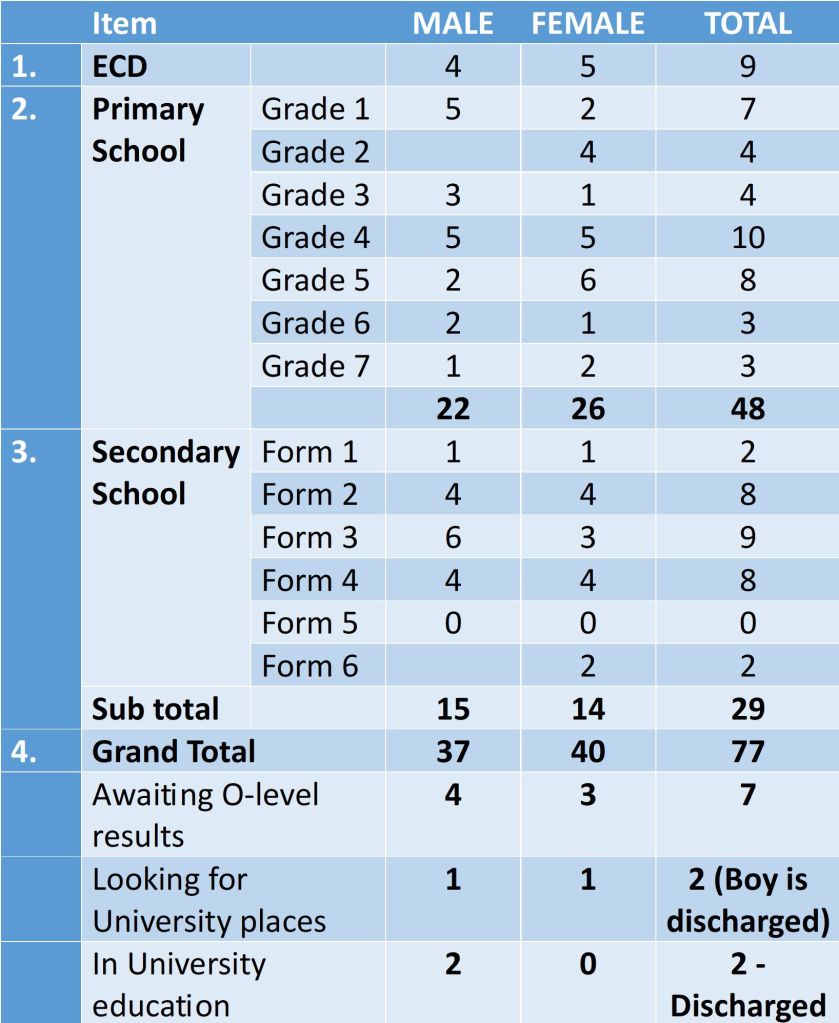
Education statistics
^ back to top ^
Day 2 Matthew Jacha Rusike’s care plan: Who is my neighbour? Luke 10: 25-37
This is the ministry of Jesus we are all called to participate in as exemplified by the Good Samaritan in Luke 10:25-37. A man is attacked by robbers and left half-dead along the way from Jerusalem to Jericho. Two great religious leaders passed by, the Priest and the Levite, both did not help the dying soul. The Samaritan man followed and made a difference.
At seeing him, he was moved with pity
Provided basic first aid care
Took him to a referral centre
Paid for the bills
Promised to come back check and pay if there were further bills
A brief history of Matthew Rusike Childcare work centres around the man, Rev Matthew Jacha Rusike, a Methodist minister who was touched by the desperate situation of the abandoned, neglected, abused and unwanted children and came up with an action plan to rescue the situation far back in the 1950s. Let us draw a few lessons from this man of God who answered to the great question WHO IS MY NEIGHBOUR in a practical way.
Need identification
When Rev Matthew Jacha Rusike was moving around doing his ministerial duties he encountered cases of disadvantaged children and orphans. Just like the good Samaritan man Rev Rusike noticed that things were not alright. We sometimes are too busy to notice situations calling for our attention because of a number of reasons. Some of the reasons are:
a. We are too busy to notice
b. We are overwhelmed by the situation; It has become so rampant that we consider it to be normal, we are used to it (tazvijaira).
c. We compare it with our own situation and think that we are worse off.
d. It does not concern us.
e. We have got other things to attend to” more pressing and more important” the list is long, you can add more reasons for our inaction.
Heart ministry
The good Samaritan was moved with pity when he saw the half dead man lying helplessly. In like manner, when the Reverend saw the plight of children, his heart was moved. The Methodist church is a movement of the heart right from its origins.
John Wesley, the founder of this movement had his heart strangely warmed during the Aldersgate experience. It is the movement of the heart which brought about great revival in England and the fire spread across continents. You can only choose to be indifferent to the issues of children if you have an iron heart. Without the heart it can never be enough. “Usipo mwoyo hazvikwani”. Hymn Methodist Shona Hymn book.
Matthew Jacha Rusike Acted decisively
He took the disadvantaged children under his care just as his own children using his own personal resources. During those times Ministers of religion were earning close to nothing. A stipend/ living allowance drawn from free will offerings given by members of the Methodist church. It is from this meagre source that the man of God:
Provided a shelter and a home to his own children and the vulnerable children he took under his care.
Provided food
Provided clothes
Provided education
Provided care and love
Looked after their health needs
Looked after their spiritual needs
In Luke 10:36, Jesus threw back the question to the Law expert and said “who of these three seems to you to have made himself neighbour to the man that fell among the robbers”.
I also ask you today: “Who of the three do you identify with?”
Action
1 Listen to the voices calling for your attention.
2 Identify their needs.
3 Respond accordingly (sometimes God gives us resources enough for our needs and the needs of the poor Samaritan at our doorstep).
Prayer
Lord our God, open our eyes and hearts to respond positively to the needs of others in difficult situations.
^ back to top ^
Day 3 Too many “Houses” and yet, very few “Homes” Luke 15:17-24
There is phenomenal growth in infrastructure development in Zimbabwe. A point to note is growth in number of houses that are being built in cities, towns, growth points, business centres, communal areas and resettlement areas. Almost everywhere in Zimbabwe there is construction work taking place. While this is a very good sign of National development, the greatest danger is the rapid expansion of the hardware without the software. The rampant social and moral ills gripping society today has left too many houses and yet very few homes. A child in Zimbabwe is gasping for a true home, were there is love, peace, care and nurturing.
Sometimes children run away from their dwelling places because they are not homes but they resemble Hell on earth. They would prefer to face the hostile life in the streets, facing sodomy, rape, hunger, diseases, harsh weather, intoxication, prostitution, wasting to drugs, violence, robbery etc than to live in mansions where there is no love, peace and care.
An ideal home is a place where the child is safe from all forms of harm. Safe from physical, emotional, social, economic, political, technological and spiritual abuse. A place where the child is treated as a child, given space, receives attention and support, nurtured in the correct way, corrected and guided in love. A home is a place where children would rush to when they are exhausted for replenishment, a place where they seek when they are wounded, where they go when they need rest and peace of mind, where they go for advice when they are stranded, where they receive social, moral and spiritual re-engineering.
Luke 15:17-24. When the prodigal son came back to his senses after wasting his life in the pleasures of this world he realized that there is a home. He became aware of his wrong doings, felt sorry for himself, and was prepared to be treated as one of his father’s labourer. But alas, to his astonishment, he found a home, where there was forgiveness, love and care. He received a hero’s welcome and a banquet was prepared for him.
A good house provides shelter, protection from bad weather, cold, rain, sun wind and other forms of physical discomfort. Such physical catastrophes have detrimental effects on children among which are physical pain and exposing them to diseases.
While physical shelter is extremely essential requirement for children as a source of
protection, childcare goes beyond shelter.
Children are in need of love, care, concern and support. They are looking for emotional space in a mansion. A child is better off growing in a shaky with a loving mum and daddy who have time for the child than in a mansion with no one to look after. They are lonely in a full house because everyone is too busy to notice and attend to their needs. They need someone to listen to their fears, challenges, likes, dislikes, failures and successes. One who shows them the direction, who walks with them through their experiences and offer a pillar of support.
Even if at times they may make serious mistakes, make wrong decision, go astray and follow the path that ruins their lives just like the prodigal son, they still need a home sweet home to look back to and make a comparison with. The prodigal son realized that there was a home better than a pigsty he was now living in, and he went back to his father’s home. He was prepared to be treated like one of his father’s servants as long as he was accepted back in the home.
The challenge we have now is that the society of today has got the hardware but does not possess the software. Too many houses and yet very few homes, too many church buildings with little or no true worship, many class rooms with very little or no education.
Action
1 Let us examine our physical structures and identify where we are falling short.
2 What can we do to make sure that the relevant software is provided for?
Prayer
Create in us dear Lord true homes, churches, schools, centres where your children obtain substance to nurture their well-being.
^ back to top ^
Day 4 The house on fire: Drugs and substance abuse menace. Psalm 46 v1-2, Psalm 121 v1-2
Drug and substance abuse among the children and youth has become a tragedy befalling our society today. It is a cross cutting challenge that knows no age limit, across all social statuses, economic classes, all religions, all political parties, the urbanites and the rural folk, the educated and uneducated, the working class and the unemployed. A real challenge threatening society to the core.
Children living in residential care facilities are no exception. As a matter of fact, some of the victims of drug and substance abuse children, especially those drawn from the streets end up in the residential care centres for rehabilitation. They also end up recruiting inmates into this life-threatening habit making the situation more precarious. More often than not, they give care givers and authorities in these institutions a torrid time.
The society is on fire due to drug and substance abuse. Each and every family in Zimbabwe is affected in one way or the other. Primary and secondary schools are battling with the war of drug and substance abuse. Pathetic situations are witnessed where learners turn to be like wild animals and are leaving schools because they can no longer cope due to drug and substance intoxication. In tertiary institutions the battle cry is the same. Wayward behaviour has become the in thing. Students are dropping out from colleges and universities.
In street corners this has become the norm, it has become fashionable especially among the youth and young people. They spend days and nights roaming in street corners either in episodes of violent behaviour or lying helplessly under intoxication. The young and energetic national asset is reduced into waste due to drugs. Productive minds and talent is being flushed into the sewage drain due to drugs. Resources which could have been channelled towards national development are now diverted to fight against drugs. Criminal activities associated to drug peddling are increasing on a daily basis. Women and children are raped, boys sodomized and cases of murder rising all under the pretext of drugs. Drug and substance abuse has become a real menace in Zimbabwe.
In as much as the Government is making efforts to curb the surge one would suggest that it be declared a national disaster. Drug and substance abuse must be a concern for every household in Zimbabwe, every institution must be involved, all Government ministries must be seized with this menace, the health sector, parliament, judiciary sector, all non-state actors, political parties, Non Governmental Organizations, churches , religious organizations, the business fraternity and the security sectors must come to the party.
This is a war calling for all and sundry to participate in to rescue generations going into extinct. Let us come together as one people and fight this scourge, clean up society and guarantee a future for our children. If we do not act decisively we are putting the future of our families in abyss, our institutions into turmoil, our churches into the den of lions and our country to the dogs. If there is something that must bring us together as a nation it is this common enemy “drug and substance abuse”. Yes it is true that some amongst us are benefiting from this shit but how many are benefiting? Furthermore, no matter the number of beneficiaries, this is a social evil which must be eradicated from our society at all cost.
Let us come together just like we did recently during the covid19 era, just like we did in response to HIV and AIDS pandemic and drawing inspiration from our struggle for liberation through a protracted and brutal war, we remained focused as a people, although we lost many lives during the war of liberation in Zimbabwe but we did not give up until we gained self rule. We need the same spirit of resilience to fight against drug and substance abuse.
Action
1 What is our response to the challenge of drug and substance abuse as:
a. Individual
b. Family
c. Communities
d. Church
2 Do you think the church is doing enough?
3 What are your suggestions to the Government?
Prayer
We pray dear Lord for the healing of victims of drug abuse, power and strength to families and support systems and the Nation at large.
^ back to top ^
Day 5 MRCH Taking Care of the Care Givers. Hebrews 6 vs 10
Matthew Rusike Children’s Home has got a full capacity of 100 children in her residential care facility in Epworth. The enrolment has 93 children under the care and support of 8 House parents. House Parents form the backbone of the childcare ministry, they are at the centre of the whole process of child upbringing and the role they play is so important. All the other structures like the management, Finance, Business unit, Health and Chaplaincy come to support this critical arm of childcare.
The House Parents are directly involved with day to day welfare of children. They welcome the children in the family units, provide them with a bed, blankets and clothes. They make sure that the children are provided with health food on time. They examine each child regularly to check that they are in good health, physically, mentally and spiritually. If the child is not well, they provide basic response if it is within their means. If it is beyond their means they immediately report to the Social Worker who in turn will report to Health Sister and or the Chaplain who will take over from there. If the challenge is beyond local capacity the Social Worker seeks outside support.
House Parents are responsible for the character formation of every child, starting from rehabilitation, unlearning bad habits, instilling discipline and good behaviour and reconstruction of the broken down moral fibre especially to children coming from damaging environments like abusive communities and street life. They also mould the children with Christian ethical standards under the close tutelage of the Chaplain and the church structures.
It is the duty of the House Parents to make sure that children under their care attend school and are responsible for the educational support which involves engaging with the teachers, assisting with home works, responding to disciplinary issues, providing tuck for boarders, lunch boxes for day scholars, ensure that they have adequate stationary, are in presentable attire, school uniform and are present for the children during school important events like Open days, Prize Giving Days, AGMs etc.
They play a very critical role in the social life of the child by helping the child to relate with himself/herself, other children and the elders surrounding his/her immediate environment. They see through the child’s development stages and identify gaps/challenges that require intervention from health practitioners, psychologists and or counsellors.
As we cherish the hard work done on a daily basis by these mothers let us also remember a plethora of challenges they face at Matthew Rusike Children’s Home. Chief among them is poor remuneration with a backlog of over four months due to inadequate financial resources. They are going for several months without a salary and yet they have their families to look after. They need to pay fees for their children, provide food, health, clothes, shelter and other amenities for their families. At the end of the day they are expected to wear a warm face, a kind and loving heart performing all the childcare duties in high spirit. Really!
Matthew Rusike Children’s Home largely depends on support from well-wishers and we are extremely grateful for the support we are receiving but this is not enough to cater for the monthly salary bill of $13000usd. It is our clarion call for the support on this critical area. We passionately appeal for financial support to cushion our hard working mothers who are toiling day and night creating a Christ woven nest for orphans and vulnerable children under our care.
Action
As we prepare for donations for Matthew Rusike Children’s Home let us remember to take care of the care givers. Any cash donation will make a difference.
Prayer thought
We pray for love, guidance and support for the House Mothers, Relief mothers, volunteers, interns and all the staff members of Mathew Rusike Children’s Home.
^ back to top ^
Day 6. Community Outreach Childcare Initiatives
Matthew Rusike children’s Home runs a community outreach program parallel to the residential child care facility in Epworth. The idea came as a brain child of Dr A. Mapurisa former National Director for Matthew Rusike Children’s Home during the period 2001-2012. We cherish the massive contribution he made towards development and transformation of Matthew Rusike Children’s Home from dormitory set up to semi-independent housing units that exist up to today. The community outreach program came as a response to the growing need by vulnerable children in communities of basic social support of food, clothes, education and healthcare. This prompted the expansion of Matthew Rusike Children’s Home programs expanding into Epworth, Chitungwiza, Gweru, Masvingo, Chinhoyi and Bulawayo in Matebeleland.
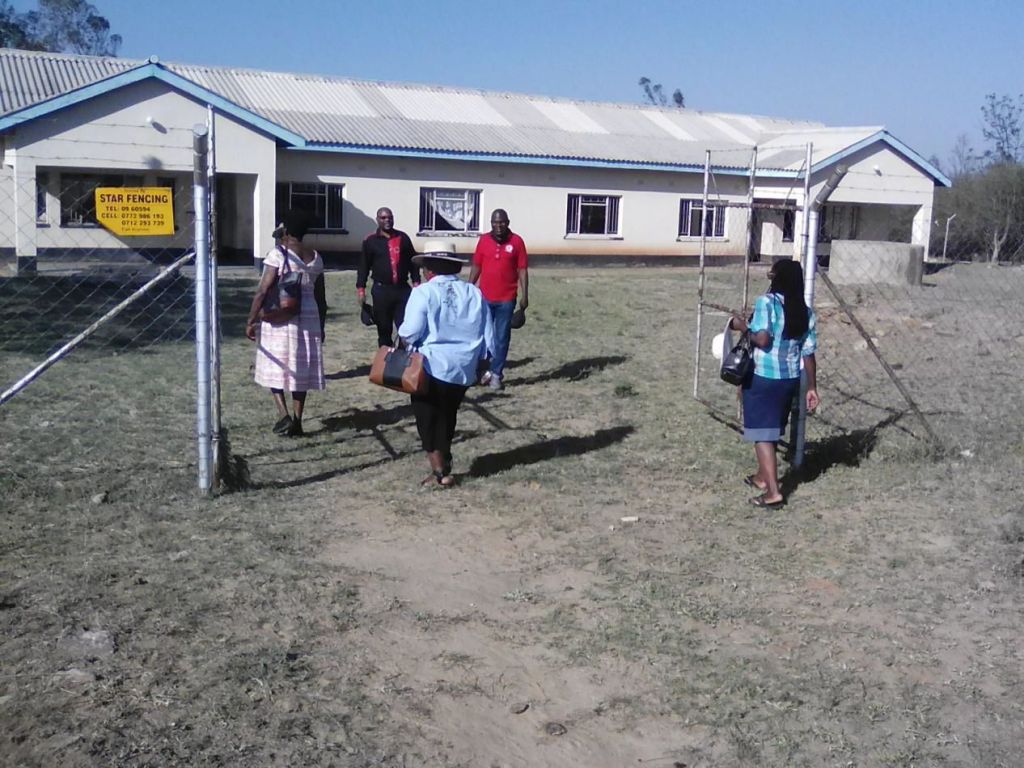
The community childcare program expansion saw the establishment of two centres in Donga, Shurugwi Midlands province and Mzinyathi centre in Matebeleland South province. Beautiful structures were built at the two centres, officers were recruited and programming started in earnest.

Key objectives of Community Outreach Childcare Centres
1 Spreading the social gospel through identifying vulnerable children in communities and respond to their various needs.
2 Partner with the Government, churches, communities and other players in the protection and care of orphans and vulnerable children.
3 Establishing income generation project towards the eradication of poverty in line with the sustainable development goals.
4 Empowering communities through training in child welfare, care and protection.
A number of activities were done including training of voluntary care givers, feeding schemes, clothing the children, offering educational support and health care. However the program did not last long due to funding challenges. The two centres went into dormancy for some time. It is at this time that Mzinyathi centre was being rented out as accommodation for students.
In 2018 Matthew Rusike Children’s Home came up with efforts to resuscitate the good work at the two centres. An officer was stationed at Donga in 2019, the General hand’s cottage and a pigsty were built and the place was fenced with barbed wire. Refurbishments were done at Mzinyathi centre and the place was also fenced.
An officer was placed at Mzinyathi centre in 2022. In March 2023 Donga centre was solarized following a donation from Friends of Matthew Rusike Children’s Home in UK. Some funds were also raised towards the solarisation of the existing bush pump, however a new borehole is required. Both centres require solar powered boreholes for meaningful projects to begin and offer support to program activities.
Appeal for support for the two Community childcare centres
1 Solar powered borehole for Donga.
2 Solar powered borehole for Mzinyathi.
3 Fencing of the Mzinyathi farm.
4 Fees support to 500 children at $25usd per child per term.
5 Furnishing the two centres.
6 Projects; Piggery at Donga and Goat at Mzinyathi respectively.
Prayer
We pray dear Lord for the childcare activities lined down in our community centres at Donga and Mzinyathi. May you give wisdom and guidance to our Childcare officers and Management committees to execute their duties diligently.
^ back to top ^
 Methodist Church: Hillside Circuit
You must be logged in to post a comment.