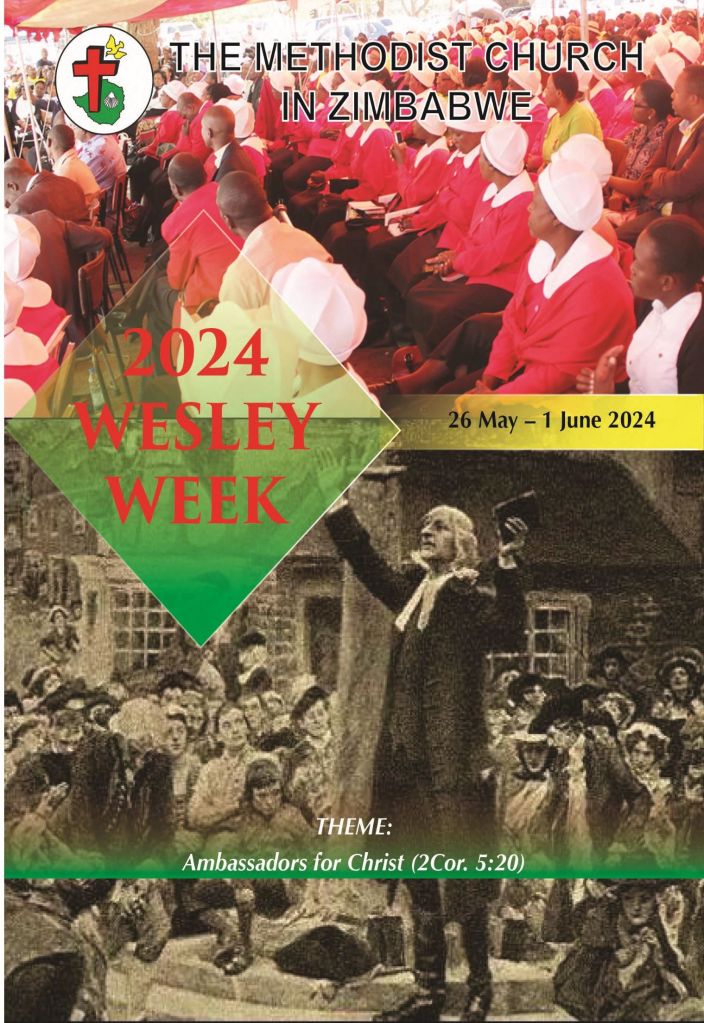
26 May – 1 June 2024
THEME: Ambassadors for Christ (2 Corinthians 5: 20)
[Click/tap on the day of your choice below to jump down the page to the devotions for that day.]
Day 1
Day 2
Day 3
Day 4
Day 5
Day 6
Day 7
FOREWORD
24 May 1738 is historical in the Methodist tradition. It is the day that brought with it a paradigm shift in John Wesley’s understanding of salvation and spiritual matters. It is also a day which is regarded as the ‘birth day’ of Methodism. In this spirit, it is our tradition as Methodist family to find time during the last week of May every year to reflect on the significance of this day as well as its aftermath effects. In so doing we revisit John, Susanna, and Charles Wesley’s lives and teachings so as to draw some inspirations that will shape our spirituality as Christians under the banner of Methodism. This reflection helps us appreciate who we are and highlight the very aspects that define our identity.
This booklet has been prepared in a way that it inspires us to understand our past, because our past has made us who we are today. It is also prepared to help us understand our present because it is a combination of our past and present that help shape our future as we seek to be true and reliable ambassadors for Christ.
May God bless the people called Methodists.
Revd. Dr. K. Paradza (Mission Director)
ACKNOWLEDGEMENTS
The Research and Publications Committee of the Methodist Church in Zimbabwe continues to thank the church leadership for the affordance of this privilege to produce and publish church literature, of which this publication of the Wesley Week booklet is one of such mandated tasks. This publication of the 2024 Wesley Week booklet was prepared by Revds. V. Zengeni and O. Chagudhuma. We thank them for their commitment and sacrifices. We thank our local languages committees for always making sure that literature is accessible to all Methodists in their mother languages. Last, but not least, we extend our gratitude to our Connexional Bookshop for always making sure that this treasure reaches all corners of the world where Methodists are found, in both soft and hard copy formats. We continue to appreciate the work that is done by our District Bishops, District Coordinators, Circuit Superintendents, Ministers, Circuit and Society R&P Coordinators in the distribution of literature.
May God bless us all.
Revd. O. Chagudhuma (Research and Publications Coordinator)
Day 1 Topic: Ambassadors for Christ
Readings: 2 Corinthians 5:20
“Give me one hundred preachers who fear nothing but sin, and desire nothing but God, and I care not a straw whether they be clergymen or laymen; such alone will shake the gates of hell and set up the Kingdom of heaven on Earth.” – John Wesley.
An ambassador is a diplomat of the highest rank who is the official representative and messenger of his/her home country in another country. Hence the Methodist Church in Zimbabwe theme this year, Ambassadors for Christ, is speaking to the church that we are Christ’s ambassadors on earth. We are in the world but not of the world. Heaven is our home, and Jesus Christ is our Lord who has sent us with a message to the world. A Christian therefore is a ‘Diplomat’ of the highest ranking in bringing Christ’s message to the world and representing his Kingdom.
Glory be to God who has given us this great church [MCZ] in which we serve Him and afforded opportunities to represent Him in different capacities. We are proud to be Methodists. The MCZ is rich in learned human resources. Ministers are doing tremendously well in academics. As of 2024, around 150 ministers in the connexion had at least a ‘first degree’, and quite a sizeable number had two. Quite a number of ministers are pursuing PhDs. This is highly commendable. On the other side, the laity are not stagnant. Our church’s lay congregants are also excelling academically. We are proud to be a church of the learned. This means that we can represent our church very well in all forums. John Wesley himself encouraged advancement in education. In one of his quotes he had this to say, “Reading Christians are growing Christians. When Christians cease to read, they cease to grow.”
On the other hand, those who belong to the secular world are also excelling academically. However, what makes us different from the learned members of the secular world is our Christlikeness. John Wesley once said that the most important component in mission is our willingness to be holy and desire God’s best in our life. Speaking about himself John Wesley said, “The first priority of my life is to be holy, and the second goal of my life is to be a scholar.” Being learned without moral and spiritual grounding is not just worthless; it is outright dangerous. Both ministers and lay members of the church are expected to be morally and spiritually upright. Only those who fear sin and desire God are able to represent Christ effectively in this world.
John Wesley as an ambassador for Christ represented Christ very well such that he is regarded as a role model, not only in the Methodist Church, but across all Christian denominations. He was so much interested in Christianity, and demanded ‘scriptural holiness’ from all those whom Christ died for. At some point he wrote, “Our main doctrines, which included all the rest, are three: That of repentance, of faith, and of holiness. …”
Reflection The fear of sin and desire for God is what is expected of us ambassadors for Christ.
Day 2 Topic: The Role of Methodist Women as Ambassadors for Christ
Readings: Mark 16: 9-11; John 20: 1-2; 2 Timothy 1: 5
“I learned more about Christianity from my mother than from all the theologians in England.” – John Wesley
On preaching, John Wesley was highly influenced by his mother Susanna Wesley to the extent that Susanna is considered as the mother of Methodism. Susanna led worship services in her home while her husband was away which was attended by her neighbours. John Wesley witnessed his mother’s effectiveness as a lay person and a woman in leading worship services and teachings.
Susanna wrote a detailed exposition of apostles creed to help her children learn about faith and this was achieved. This made John Wesley even more confident about the capability of women in doing and supporting God’s work. He befriended the young, the old, the married, the singles, the middle class and the poor. The women had common characteristics; they were evangelical believers and mostly Methodist. Apart from being evangelical they were hyper active and committed. Above all they were not afraid of hard work. This behaviour clearly indicated that both men and women are called to serve.
In 1787, despite the objection of his male preachers, John Wesley allowed Sarah Mallete to preach and the results were tremendous. The Methodist Church in Zimbabwe has inherited this understanding and practice from him, and has created a level field for women to be involved in mission driving. In this understanding, women’s organisations such as the Ruwadzano/Manyano, Girls’ Christian Union (GCU), Women’s Association (WA), etc, have been put in place so as to afford women platforms for fellowshipping and spreading the Gospel of Jesus Christ. In addition to their active participation in these women’s organisations, there are women in the MCZ who conduct worship services on a weekly basis in their capacities as ‘Preachers on Full Plan’ as well as ‘Full time itinerant Ministers’. Men and women are equal before God.
From the above provided verses, i.e. Mark 16 and John 20, we encounter women being the first witnesses [preachers] of the message of resurrection, and their testimonies left an indelible mark in the history of Christianity. The author of the second letter to Timothy reminds Timothy about the role which women, i.e. his grandmother and mother, played in his faith. In other words, the author is just saying that Timothy inherited a special portion of faith from these two women. Had it not been because of the faith and influence of these women, Timothy would not have been where he was, hence women are very powerful and reliable ‘ambassadors for Christ’ at home and in the pulpit.
Reflection What are some of the challenges being faced by women in serving God? How best can we address them?
Day 3 Topic: A Fellowshipping Church – Class Meetings
Readings: Acts 2: 42-47, Hebrews 10: 24-25
“Preaching like an Apostle, without joining together those that are awakened and training them up in the ways of God, is only begetting children for the murderer.” – John Wesley
The Methodist Church class meetings provided a strong foundation to the original Methodist Movement to give witness to Jesus Christ in the world, and follow his teachings through the acts of compassion, justice, worship and devotion under the guidance of the Holy Spirit. Class meetings is one of the pillars which contributed to the survival of the Methodist Church since 1742. John Wesley believed that advice, dispute resolution could be peacefully given at class meetings.
The purpose of class meetings is:
- Mutual accountability to one another.
- Support and encourage each other to walk with God.
- To give witness to Jesus Christ in the world, and to follow his teachings through acts of compassion, justice, worship, devotion under the guidance of the Holy Spirit.
- Help members to grow and come to know Jesus Christ and learn how to live a Christ-like life.
Having seen the tremendous results that were being realized through ‘Class Meetings’ John Wesley wrote that, “Upon reflection, I could not but observe, this is the very thing [Class Meetings] which was from the beginning of Christianity. In the earliest times, those whom God had sent forth ‘preached the Gospel to every creature.’ … But as soon as any of these were convinced of the truth, as to forsake sin and seek the Gospel salvation, they immediately joined them together, took account of their names, advised them to watch over each other, …” (Works of John Wesley, 1831: 177). Class Meetings became a mark of a Methodist as they had the basis in scripture. Between 1745 and 1748 John Wesley and his Methodist movement neglected class meetings and things started to fall apart. Having realized the negative results of neglecting class meetings John Wesley wrote that, “The church recruited people who had been starched and ironed before they were washed.”
The contemporary Methodist Church in Zimbabwe still upholds the idea of class meetings although in some cases struggling to entirely follow John Wesley’s process. Class meetings are still helping because they increase the likelihood that people will move forward in their faith simply because they still join people together in small groups so that people are not lost in church. Furthermore, class meetings draw attention every week to the reality that Christian life is non static. In this understanding, no one can claim to be a Methodist when she/he does not belong to a functioning class. “A Methodist is ‘one who lives according to the ‘method’ laid down in the Bible’.” – John Wesley
Reflection How best can we strengthen our Class Meetings ‘for effective delivery’?
Day 4 Topic: Methodism and Giving
Readings: 2 Corinthians 9: 7-15
“When a man becomes a Christian, he becomes industrious, trustworthy and prosperous. Now, if that man, when he gets all he can and saves all he can, does not give all he can, I have more hope for Judas Iscariot than for that man!” – John Wesley
John Wesley understood that one of the marks of true Christianity is that of giving generously. Methodists do not come across a need and leave it unattended. In his sermon on ‘The Use of Money’ John Wesley highlighted three key principles that have to be followed if one is to be in good relationship with God as well as with fellow humans, and these are, “earn all you can, save all you can, and give all you can.”
However, towards the end of his life, i.e. about 30 years after he had preached the sermon on ‘The use of Money’, John Wesley reflected on how the Methodist movement had grown, with membership of around 50 000 in England alone, and noticeable growth in other countries as well. As he reflected on the rapid growth of the movement John was concerned about the growing wealth of the Methodist vis-à-vis their response to Christian social responsibilities. He saw the growth in wealth as a threat to true Christianity. His worry was no longer on church membership but on misdirected priorities on the people called Methodists, and such misdirected priorities being a threat to true Christianity. Expressing his fears, he wrote on the 4th of August 1786 that, “I am not afraid that the people called Methodists should ever cease to exist either in Europe or America. But I am afraid, lest they should exist only as a dead sect, having the form of religion without power. And this undoubtedly will be the case, unless they hold fast both the doctrine, spirit, and discipline with which they first set out.”
John Wesley considered wealth and failure to give as the most serious threats to the Methodist movement in particular, and Christianity in general, and these two continue to remain a threat even today in the MCZ. In 1789 John Wesley noted that Methodists had mastered two of the three principles, i.e. they had earned all they could, and saved all they could, but had ignored the third principle, i.e. that one of giving all they can. If one would take a close look at the current scenario in the MCZ would agree that, just as it was in the late 18th century, [John Wesley’s last days] the majority have, and are mastering the first two principles of earning and saving but having problems with the third one.
The MCZ has got a rich population. They are found in all sectors of the economy but the church struggles to have enough resources to carry out the mission of spreading the Gospel as well as looking after the vulnerable members of society. Money is there in people’s pockets but is not brought to the altar. The end result is that we are deceived by our population [numbers]; high population without tangible fruit of the spirit, thereby leading us to a path of a dead sect which John Wesley feared would characterize this great movement. Self-introspection is needed by all of us before it is too late. On the same subject John Wesley wrote, “… And yet nothing can be more plain than that all who observe the first rules without the third will be twofold more the children of hell that they were before.” John Wesley’s commitment to giving was consistent throughout his life. If we are true Methodists and true Christians, we have to take a leaf from him.
Reflection Are you not mastering the first two principles and ignoring the third one? There is need for self-introspection!
Day 5 Topic: Preaching and Worshipping through Music
Readings: Judges 5: 2-31, Exodus 15: 20-21
In as much as the ancient Israelites would respond to who God is and what He would have done to them in psalms and dance, so it is with Methodist theology of music. The Methodist Hymn Book is a collection of psalms which are an expression of our faith with regard to who God is, what He would have done to us, and what He continues to do. This has been like that since the eighteenth century. Charles Wesley was a great hymn composer and his hymns are still in use in our worship services today, i.e. both in our English and vernacular services. These hymns reinforce the beliefs and theology of the Methodist movement. Music is an essential ingredient of the preaching service, because it supplements the word.
However, as has been pointed out before, this did not start with Charles. He inherited it from the ancestors in faith, i.e. ancient Israel, and passed it over to generations, right to our time. From the verses provided above, we are presented with incidents where music is used as an expression of trust and gratitude to who God is and what He does, especially His act of fighting for His people.
Furthermore, preaching through music is just as good as open air preaching. It is used on funerals, weddings, and tombstone unveilings, only to mention a few, to draw people to Christ.
The melody and phrasing of the music makes our faith memorable. Music touches the heart. At some point John Wesley has this to say as he encourages people called Methodist to sing in spirit and skilfully, “Sing lustily and with good courage. Beware of singing as if you were half dead or half asleep. Do not bawl so as to be heard above the rest of the congregation but strive to unite your voices together”
Music has a way of piercing into deep parts of our souls that assists in our expression and response to God and to the church. Singing helps unite the church.
Reflection Through music we praise and worship God. What are the threats being posed by certain choruses to our Methodist theology?
Day 6 Topic: The Evil of Drug and Substance Abuse
Readings: Proverbs 23: 20-21, 29-32; Habakkuk 2: 15-16
“Are you a man? God made you a man; but you make yourself a beast. Wherein does a man differ from a beast? Is it not chiefly in reason and understanding? But you throw away what reason you have. You strip yourself understanding. You do all you can to make yourself a mere beast, not a fool, not a madman only, but a swine, a poor filthy swine. …” (John Wesley, ‘Word to a Drunkard’)
Drug and substance abuse is a menace that is tearing the social, religious, economic and moral fabric of the society. The church is not spared from the effects of this evil. This is because the drug and substance addicts are in one way or the other having connections with the church members; and it cannot be disputed that some of these addicts are church members. Apart from that, church members do not live in a vacuum. They live in the same world [society] where the addicts live in. This means that that which causes the young people out there to indulge in drug and substance abuse is also at their disposal, hence we ought to be on guard.
However, it is not only the addicts [abusers] who should be our target. There are perpetrators to this menace, and John Wesley had no kind words on such perpetrators in the 18th century, the same way we should not have kind words on such perpetrators of our time. History of Methodist theology shows us that John Wesley was very comprehensive in his approach. He did not only rebuke the poor miserable drunkards themselves, but likewise rebuked liquor-sellers who are guilty of producing drunkards in the first place. On 11 March 1743 he took strong actions against drunkards that were in the church. He did not end there, but was against this evil throughout his ministry. On 14 February 1744 John Wesley preached a sermon titled, “On the Use of Money”. In the sermon he pointed out that, “Neither may we gain by hurting our neighbour in his body. Therefore we may not sell anything which tends to impair health.” John Wesley called for complete abstinence from anything alcoholic and toxic, and decried those who sold alcohol as ‘poisoners’ and ‘murderers’. His understanding was that the only proper place for alcohol was in ‘hell’. The understanding which John Wesley had, and which the current Methodist Christians have is that any consumption of alcohol is morally corrosive and evil is inherently present in the substance. Drinking alcohol and abusing drugs is inviting evil into one’s body. John Wesley’s stance was based on the biblical principles, especially Proverbs 23 given above. According to the author of the book of Proverbs, there is absolutely nothing good that comes out from taking alcohol or abusing drugs, and Christians, both the old and young, should be warned accordingly.
Reflection What lessons can the modern day Methodist church learn from John Wesley’s approach in dealing with the menace of drug and substance abuse?
Day 7 Topic: Staying in love with God
Readings: John 15: 1-12; Romans 8: 35-39; 1 John 4: 7-12
“Religion is the love of God and our neighbour, that is, every man under heaven.” – John Wesley
John Wesley summarized Christian living into three simple rules, i.e. “do not harm, do good, and stay in love with God”. Key in this summary is that John Wesley wrote that if you don’t do the third one, i.e. staying in love with God, you won’t have the power to do the other two.” This shows how powerful love is. It enables, and opens avenues for all other facets to be achievable.
John Wesley’s best sermons were on the love of God. They warmed cold hearts. He said, “When we look trustingly to Christ the love of God is poured into our hearts by the Holy Spirit. Then we can pour out our hearts with love for God, friends, strangers and even enemies. Being in love with God means giving him what he deserves, which is nothing less than love.”
To fall in love with God, we must spend time in his word. The more time one spends in the word of God, the more He will begin to speak to you. Prayer is also important as that is when we speak to God. Job stayed in the word of God hence he was in love with God, which explains why he was not shaken during his tough times because love conquers everything.
To stay in love with God:
- Cultivate a mindset of a relationship with God.
- Cultivate a heart of gratitude towards God.
- Spend quality time in worship, expressing your gratitude to him.
- Look at God’s love as a love letter.
- Read his word with expectation to hear and see something new from God.
- Ask the Holy Spirit questions.
Reflection Love God because He first loved you with everlasting love. Our love for God is manifested as we extend it to others. One who loves fellow humans loves God. Are you one of us in loving God?
 Methodist Church: Hillside Circuit
You must be logged in to post a comment.